
How Olivaro Works: Proposed Mechanisms, Dose Reality and a Self-Test
Four biological routes, borrowed from studies of single ingredients. What each one needs to work, what the bottle can supply, and a fair way to judge the result with your own meter.
The short answer
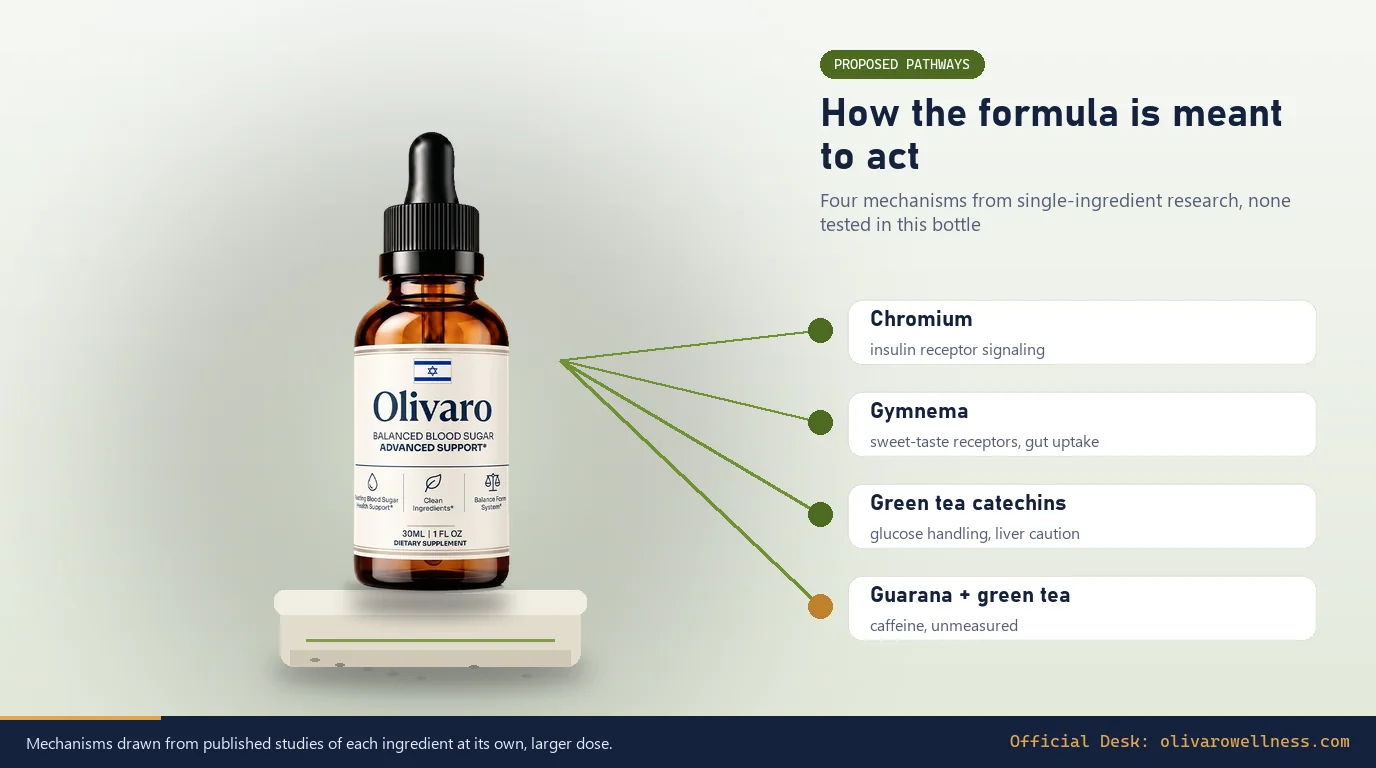
Nobody knows exactly how Olivaro works, because nobody has tested it. There is no published trial of the finished drops in any group of people. What exists is a set of proposed mechanisms borrowed from studies of single ingredients, nearly all of them at doses many times larger than what fits in this bottle.
That does not make the mechanisms imaginary. Chromium does take part in insulin signaling, gymnema does block sweet taste, and caffeine does raise alertness. The open question is whether the amounts inside one milliliter are large enough to move any of those systems in a way you could measure. This page explains each route in plain language and then gives a way to test the product on yourself.
How the body controls blood sugar, in one page
After a meal, carbohydrates are broken down to glucose, which enters the blood. The pancreas releases insulin, and insulin tells muscle, fat and liver cells to take glucose in. Muscle cells move glucose transporters (GLUT4) to their surface; the liver stores glucose as glycogen and slows its own glucose output. Between meals and overnight, the liver releases glucose to keep levels steady [1].
In insulin resistance, cells respond less to the same amount of insulin. The pancreas compensates by making more, and for years blood sugar can stay normal. When it can no longer keep up, fasting glucose drifts above 100 mg/dL and post-meal peaks get higher and last longer: the stage called prediabetes [2].
Supplements aimed at glucose usually claim to act at one of four points: making cells more responsive to insulin, slowing the arrival of glucose from the gut, increasing energy use, or tempering stress hormones that raise glucose. Olivaro's 23 entries touch all four, which sounds thorough but also means each point gets a sliver of the 200 mg.
Route 1: insulin sensitivity (chromium, ginseng, green tea)
Chromium appears to help the insulin receptor pass its signal on inside the cell; people with real chromium deficiency, which is rare, develop glucose intolerance that reverses with supplementation [3]. In people who are not deficient, trials at 200 to 1,000 mcg a day gave small and inconsistent effects [4][5]. Olivaro supplies 0.7 mcg.
Panax ginseng contains ginsenosides that, in lab studies, increase glucose uptake. Pooled human trials of the root found a small fall in fasting glucose [7]. Olivaro's ginseng is an aerial extract, and its weight is undisclosed.
Green tea catechins improved fasting glucose modestly in a meta-analysis, with no clear effect on insulin or A1C [6]. The trials used several hundred milligrams of extract per day.
Route 2: sweet taste and carbohydrate uptake (gymnema)
Gymnemic acids have a shape similar to glucose. On the tongue they sit in the sweet receptors and, for up to an hour, make sugar taste like sand [8]. In the gut they may slow glucose absorption. People who chew the leaf report fewer cravings, which is the logic behind the vendor's "sugar destroyer" line.
The glucose-lowering results in people come from about 400 mg a day of a standardized extract, often given with existing medication [9]. Swallowing a milliliter of liquid that holds an unknown slice of a 200 mg blend gives gymnema only brief contact with the tongue, so the taste effect may be faint.
Route 3: weight and energy use (African mango, coleus, capsicum, caffeine)
Excess weight, especially around the waist, is a major driver of insulin resistance, so several entries target weight. African mango reduced weight and fasting glucose in one well-known trial [10], but reviewers found the evidence base thin [11]. Capsaicin nudges energy use upward by a few dozen calories a day at doses far above this one [12]. Coleus (forskolin) has small, mixed trials.
Caffeine from guarana and green tea raises alertness and slightly increases energy expenditure. In some people it can also raise blood glucose for a short time. The FDA's general ceiling for healthy adults is 400 mg a day [13]; Olivaro does not say how much it contains.
Route 4: stress, sleep and hormones (maca, eleuthero, astragalus, GABA, tryptophan)
Stress hormones such as cortisol and adrenaline raise blood glucose, and poor sleep worsens insulin resistance the following day. Adaptogenic herbs are marketed to soften that stress response. The evidence is mostly small, short and focused on how people feel rather than on glucose: maca's best data concern mood and libido [14], and NCCIH describes ginseng's human evidence as limited for most uses [15].
GABA and tryptophan relate to calm and sleep. At the milligram amounts possible here, they are better thought of as label ingredients than as active doses, though tryptophan still matters as an interaction with serotonin-acting drugs.
Does Olivaro act like a GLP-1 drug?
No. GLP-1 is a hormone the gut releases after eating; it boosts insulin, slows stomach emptying and dampens appetite. Your own GLP-1 is broken down within minutes. Drugs such as semaglutide and tirzepatide are engineered to resist that breakdown and act for days, which is why their effects on weight and A1C are large [17].
The closest link in Olivaro's formula is glutamine. In one study, 15 g of glutamine before a meal increased GLP-1 and lowered the post-meal glucose rise in people with type 2 diabetes [16]. The whole Olivaro blend is 200 mg. No ingredient on the panel is a GLP-1 receptor agonist, and none of the marketing should be read that way.
Why dose decides whether a mechanism matters
Almost every biological effect follows a dose-response curve: below a threshold nothing measurable happens, then the effect rises with dose until it levels off. Research is valuable precisely because it tells us where that threshold lies for each ingredient.
| Mechanism | Ingredient | Dose in positive studies | Olivaro, per mL |
|---|---|---|---|
| Insulin signaling | Chromium | 200-1,000 mcg | 0.7 mcg |
| Sweet-taste block | Gymnema | ~400 mg | under 200 mg |
| Fasting glucose | Green tea | several hundred mg | under 200 mg |
| Weight | African mango | 300 mg | under 200 mg |
| Fasting glucose | Panax ginseng root | 1-3 g | under 200 mg, aerial |
| GLP-1 release | Glutamine | 15 g | under 200 mg |
Each "under 200 mg" is a ceiling shared with 21 other names. Taking two droppers doubles every number but closes few of the gaps. That is the core reason this desk expects gentle effects at most.
How to test Olivaro on yourself
Because no trial answers the question for you, the fairest test is your own, run inside the refund window.
- Baseline week. Before the first dropper, take seven fasting readings at the same time each morning.
- Hold everything else steady. Same meals, same activity, same sleep schedule, same medicines. A ten-minute walk after meals lowers post-meal peaks on its own [18], so if you start walking, start before the baseline week.
- One dropper each morning for at least 30 days, as the vendor asks.
- Compare averages around day 45 to 50. Moves under about 5 mg/dL are within meter noise.
- Decide before day 60. If you see no clear change, request the refund.
Whatever the result, the habits that carry the strongest evidence (weight loss of 5 to 7%, 150 minutes of weekly activity and better carbohydrate quality) remain worth more than any supplement [19][20][21].
Questions readers send about this
How does Olivaro work?
According to the vendor, through chromium for insulin response, gymnema and African mango for sugar absorption, and maca and ginseng against fatigue. Those mechanisms come from single-ingredient studies at much larger doses; the finished drops have never been tested.
How fast does Olivaro work?
There is no data on timing for this product. Given the small amounts, any effect is likely to be gradual and modest. Judge it on four to seven weeks of logged readings, not on how you feel in the first days.
Does Olivaro lower A1C?
No study has measured it. A1C reflects about three months of glucose, so it cannot judge a 60-day trial anyway. Ask your clinician before using any supplement in hopes of changing A1C.
Can Olivaro replace metformin?
No. Metformin has decades of outcome data and works at 500 to 2,000 mg a day. Olivaro is a supplement with undisclosed amounts and no trial. Never stop or reduce a prescription without your prescriber.
Is it better under the tongue?
The label says to place the drops in the mouth and swallow. Holding them under the tongue first is harmless, but no evidence shows this blend absorbs better that way, despite a bonus guide's mention of sublingual absorption.
Records cited on this page
Links go to the original abstract or agency page. Every trial below gave one ingredient on its own, mostly at doses far above what a 200 mg blend shared by 22 names could hold; nobody has published a trial of Olivaro itself.
- 1MedlinePlus (U.S. National Library of Medicine). Blood Sugar. medlineplus.gov/bloodsugar.html
- 2National Institute of Diabetes and Digestive and Kidney Diseases. Insulin Resistance & Prediabetes. www.niddk.nih.gov/health-information/diabetes/overview/what-is-diabetes/prediabetes-insulin-resistance
- 3NIH Office of Dietary Supplements. Chromium: Fact Sheet for Health Professionals. ods.od.nih.gov/factsheets/Chromium-HealthProfessional/
- 4Anderson RA, Cheng N, Bryden NA, et al. Elevated intakes of supplemental chromium improve glucose and insulin variables in individuals with type 2 diabetes. Diabetes. 1997;46(11):1786-1791. pubmed.ncbi.nlm.nih.gov/9356027/
- 5Costello RB, Dwyer JT, Bailey RL. Chromium supplements for glycemic control in type 2 diabetes: limited evidence of effectiveness. Nutr Rev. 2016;74(7):455-468. pubmed.ncbi.nlm.nih.gov/27261273/
- 6Liu K, Zhou R, Wang B, et al. Effect of green tea on glucose control and insulin sensitivity: a meta-analysis of 17 randomized controlled trials. Am J Clin Nutr. 2013;98(2):340-348. pubmed.ncbi.nlm.nih.gov/23803878/
- 7Shishtar E, Sievenpiper JL, Djedovic V, et al. The effect of ginseng (the genus Panax) on glycemic control: a systematic review and meta-analysis of randomized controlled clinical trials. PLoS One. 2014;9(9):e107391. pubmed.ncbi.nlm.nih.gov/25265315/
- 8Kanetkar P, Singhal R, Kamat M. Gymnema sylvestre: a memoir. J Clin Biochem Nutr. 2007;41(2):77-81. pubmed.ncbi.nlm.nih.gov/18193099/
- 9Devangan S, Varghese B, Johny E, et al. The effect of Gymnema sylvestre supplementation on glycemic control in type 2 diabetes patients: a systematic review and meta-analysis. Phytother Res. 2021;35(12):6802-6812. pubmed.ncbi.nlm.nih.gov/34467577/
- 10Ngondi JL, Etoundi BC, Nyangono CB, Mbofung CM, Oben JE. IGOB131, a novel seed extract of the West African plant Irvingia gabonensis, significantly reduces body weight and improves metabolic parameters in overweight humans in a randomized double-blind placebo controlled investigation. Lipids Health Dis. 2009;8:7. pubmed.ncbi.nlm.nih.gov/19254366/
- 11Onakpoya I, Davies L, Posadzki P, Ernst E. The efficacy of Irvingia gabonensis supplementation in the management of overweight and obesity: a systematic review of randomized controlled trials. J Diet Suppl. 2013;10(1):29-38. pubmed.ncbi.nlm.nih.gov/23419021/
- 12Ludy MJ, Moore GE, Mattes RD. The effects of capsaicin and capsiate on energy balance: critical review and meta-analyses of studies in humans. Chem Senses. 2012;37(2):103-121. pubmed.ncbi.nlm.nih.gov/22038945/
- 13U.S. Food and Drug Administration. Spilling the Beans: How Much Caffeine Is Too Much? www.fda.gov/consumers/consumer-updates/spilling-beans-how-much-caffeine-too-much
- 14Gonzales GF. Ethnobiology and ethnopharmacology of Lepidium meyenii (Maca), a plant from the Peruvian highlands. Evid Based Complement Alternat Med. 2012;2012:193496. pubmed.ncbi.nlm.nih.gov/21977053/
- 15National Center for Complementary and Integrative Health. Asian Ginseng. www.nccih.nih.gov/health/asian-ginseng
- 16Samocha-Bonet D, Wong O, Synnott EL, et al. Glutamine reduces postprandial glycemia and augments the glucagon-like peptide-1 response in type 2 diabetes patients. J Nutr. 2011;141(7):1233-1238. pubmed.ncbi.nlm.nih.gov/21593352/
- 17Drucker DJ. Mechanisms of action and therapeutic application of glucagon-like peptide-1. Cell Metab. 2018;27(4):740-756. pubmed.ncbi.nlm.nih.gov/29617641/
- 18Reynolds AN, Mann JI, Williams S, Venn BJ. Advice to walk after meals is more effective for lowering postprandial glycaemia in type 2 diabetes mellitus than advice that does not specify timing: a randomised crossover study. Diabetologia. 2016;59(12):2572-2578. pubmed.ncbi.nlm.nih.gov/27747394/
- 19Knowler WC, Barrett-Connor E, Fowler SE, et al. Reduction in the incidence of type 2 diabetes with lifestyle intervention or metformin. N Engl J Med. 2002;346(6):393-403. pubmed.ncbi.nlm.nih.gov/11832527/
- 20Reynolds A, Mann J, Cummings J, et al. Carbohydrate quality and human health: a series of systematic reviews and meta-analyses. Lancet. 2019;393(10170):434-445. pubmed.ncbi.nlm.nih.gov/30638909/
- 21National Center for Complementary and Integrative Health. Using Dietary Supplements Wisely. www.nccih.nih.gov/health/using-dietary-supplements-wisely
Give Olivaro a measured 60-day trial
Checkout happens on the vendor's BuyGoods page. Note a week of morning readings before the first dropper; if the numbers have not moved by day 50, write to the vendor while the refund window is still open, opened bottles included.